Force and Motion MCQs for MDCAT Practice
Physics section, Force and Motion chapter. Up to eight free sample questions, each with the correct answer and a worked explanation. The full chapter opens in the app.
The bank has 1,521 active questions on this chapter. Your first 500 practice attempts are free, and every attempt includes a worked explanation.
- Question 1When upward acceleration of an elevator is increased the weight of the body in it is
- Zero
- Further increased (correct answer)
- Negative
- Constant
Correct answer: BIncreasing an elevator's upward acceleration increases the apparent weight of a body inside due to a greater normal force required to produce the acceleration. - Question 2Two wires of equal length and cross-section are suspended as shown. Their Young’s moduli are Y1 and Y2, respectively. The equivalent Young’s modulus will be:
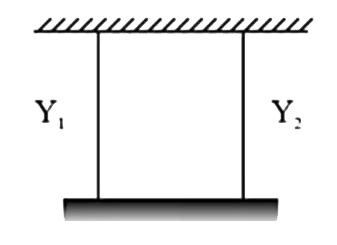
- Y1 + Y2
- (Y1 + Y2) / 2 (correct answer)
- (Y1 * Y2) / (Y1 + Y2)
- √(Y1 * Y2)
Correct answer: BTwo identical wires connected in parallel share the same extension; the equivalent Young's modulus is the arithmetic mean (Y1+Y2)/2 since stresses add while strain stays equal. - Question 3An object with an initial velocity of 40m/s moves along a straight axis under constant acceleration. Three seconds later,its velocity is 14m/s. How far did it travel during this time?
- 81 m (correct answer)
- 17 m
- 67 m
- 57 m
- 77 m/s
Correct answer: ACalculate displacement under constant acceleration using initial velocity, final velocity, and time. This problem tests kinematic equations. - Question 4Which of the following expressions represent (8x3 + 125) / (2x + 5)?
- 4x2 – 10x – 25
- 4x2 – 20x + 25
- 4x2 + 10x + 25
- 4x2 – 10x + 25 (correct answer)
Correct answer: DThis question tests algebraic manipulation, specifically the sum of cubes factorization, a common tool in physics problem-solving. - Question 5An object is taken from the earth to a planet where the value ‘g’ is 20 m/s2, if it is compared with value of ‘g’ earth, which of the following statement is true?
- Weight at the planet will be greater (correct answer)
- Weight at the Earth will be greater
- Mass at the planet will be greater
- Mass at the planet will be smaller
Correct answer: AThis question tests the distinction between mass and weight, and how weight changes with gravitational acceleration. - Question 6A fireman wants to slide down a rope. The breaking load of the rope is 3/4 of the weight of the man. With what acceleration should the fireman slide down? (Acceleration due to gravity is 'g')
- g
- g/4 (correct answer)
- 3g/4
- 0
Correct answer: BThis question tests understanding of Newton's second law applied to a scenario involving tension and weight, specifically when the breaking point of a rope is a factor. - Question 7For a given value of initial velocity, the maximum range of a projectile can be achieved by throwing it at an angle of:
- 90°
- 60°
- 45° (correct answer)
- 30°
Correct answer: CMaximize projectile range by launching at 45° for a given initial velocity, a fundamental concept in projectile motion. - Question 8A ball is projected vertically upwards from the ground with a velocity of 20 m/s. How high will it go? (Take g = 10 m/s2)
- 5 m (correct answer)
- 10 m
- 15 m
- 20 m
- 25 m
Correct answer: ACalculate maximum height of a vertically projected object using kinematic equations, considering gravity's deceleration.
Practise all 1,521 Force and Motion questions
A free account keeps your correct, incorrect and unseen questions separate, and shows the explanation after every attempt.
Create a free accountRead the full Force and Motion chapter notes: Force and Motion notes. Or browse every chapter.